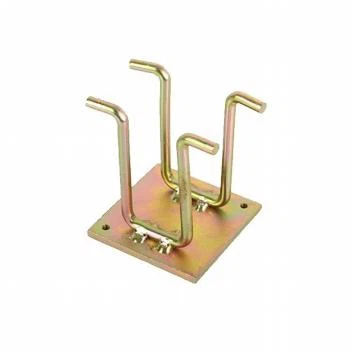
Product Overview
A Threaded Socket Insert is a metal sleeve with an internal threaded hole that is placed inside a concrete mold before pouring. After the concrete cures, the insert becomes permanently anchored inside the structure, providing a ready-to-use threaded fixing point for bolts, lifting devices, brackets, supports, and mechanical components.
We manufacture high-strength Threaded Socket Inserts designed for permanent, cast-in-place anchoring in precast concrete panels, beams, columns, and infrastructure elements. Engineered to replace failure-prone post-installed anchors, our inserts provide certified load transfer, accurate thread alignment, and zero damage to concrete integrity.
Certified under ISO 9001 and compliant with international precast hardware standards, we deliver bulk standard inserts and custom OEM solutions to precast yards, structural engineers, and global procurement managers.
Cast-in Socket Inserts Outperform Post-Installed Anchors
|
Evaluation Factor |
Cast-In Threaded Socket Inserts |
Post-Installed Expansion Anchors |
Chemical Adhesive Anchors |
|
Installation Timing |
Installed in formwork before pour |
Drilled after concrete cures |
Drilled & injected after cure |
|
Concrete Damage Risk |
Zero (No stress micro-cracks) |
High (Expansion stress) |
Moderate (Spalling during drilling) |
|
Load Transfer Mechanics |
Direct mechanical interlock |
Friction / Compression |
Chemical bonding |
|
Installation Speed |
Instant bolt engagement |
Labor-intensive drilling & cleaning |
Curing wait time required |
|
Rebar Damage Risk |
Zero (Positioned before pour) |
High (Drill bit interference) |
High (Drill bit interference) |
|
Total Project Labor Cost |
Low |
High |
Very High |
Engineering Features & Mechanical Advantage
1. High-Interlock Anchorage Geometry
Knurled & Ribbed Exterior: Prevents rotational spinning inside the concrete matrix during high-torque bolt tightening.
Forged Foot Base: Distributes tensile loads deep into the concrete core, maximizing pull-out capacity in thin-walled precast panels.
Cross-Hole Design: Allows rebar to pass directly through the insert body for extra structural tie-in where extreme dynamic loads exist.
2. High-Precision Internal Threads
All threads are formed through cold heading or precision CNC thread rolling, followed by Go/No-Go plug gauge inspection. This guarantees zero thread binding during job-site assembly of lifting eyes, connection brackets, or equipment bases.
3. Integrated Anti-Ingress Protection
Concrete slurry leakage into internal threads causes costly job-site rework. Every order can be supplied with plastic sealing plugs, rubber cap closures, or removable foam inserts to keep internal threads completely clean during casting and vibration.
Technical Specifications & Product Range
Material Grades & Corrosion Protection
Carbon Steel (Class 4.8 / 8.8): Ideal for dry interior concrete applications, temporary lifting points, and unexposed structural joints.
Hot-Dip Galvanized Steel (HDG): Zinc coating thickness compliant with ISO 1461 (50um to 85um). Offers 500+ hours of salt spray resistance for outdoor infrastructure and exterior sandwich wall panels.
Stainless Steel (AISI 304 / AISI 316): Recommended for marine environments, chemical processing plants, water treatment facilities, and highly corrosive coastal infrastructure.
Technical Data Overview
|
Parameter |
Standard Specification |
|
Product Name |
Threaded Socket Insert / Cast-In Concrete Socket |
|
Thread Type |
Metric (M8, M10, M12, M16, M20, M24, M30) / Imperial (3/8", 1/2", 5/8", 3/4", 1") |
|
Thread Standard |
ISO Metric Coarse, UNC, UNF |
|
Manufacturing Process |
Cold Heading, Hot Forging, CNC Machining, Thread Rolling |
|
Surface Finishes |
Yellow/White Zinc Plating, Hot-Dip Galvanizing (HDG), Dacromet, Passivated |
|
Load Types |
Axial Tension, Shear Load, Combined Tension/Shear, Temporary Lifting |
|
Quality Control |
100% Thread Gauge Check, Tensile Load Testing, Chemical Analysis |
|
Certifications |
ISO 9001:2015, EN 10204 3.1 Material Certificate, CE Marking Compliance |
Quality Assurance
Raw Material Inspection: Every coil or rod of steel undergoes spectrographic chemical analysis and mechanical tensile testing before entering production.
Dimensional & Thread Testing: CNC machining operators perform dimensional audits every 30 minutes. Internal threads are verified using calibrated Go/No-Go plug gauges.
Coating & Plating Integrity: Coating thickness is checked with digital magnetic gauges. Hot-dip galvanized batches undergo neutral salt spray testing (NSS) to verify corrosion resistance.
Destructive Pull-Out Testing: Representative concrete block samples are poured in-house to verify SWL (Safe Working Load) and ultimate failure load ratings under tension and shear.
Full Traceability: Every shipment is issued with an EN 10204 3.1 Material Test Certificate referencing heat numbers, yield strength, tensile strength, and elongation percentage.
OEM & Custom Manufacturing Process
For specialized infrastructure projects or proprietary precast building systems, we offer end-to-end custom manufacturing based on customer CAD models or physical samples.
Drawing & Engineering Review: Submit your 2D/3D CAD drawings (STEP, DWG, PDF). Our engineers review thread geometry, clearance, and concrete load distribution.
Tooling & Prototyping: Custom tooling is produced in-house. Initial samples (5 to 10 pcs) are manufactured within 5 to 7 business days for customer evaluation.
Mechanical Testing: Samples undergo tensile strength, thread fit, and plating adhesion checks.
Mass Production: Automated cold heading and CNC lines execute volume production with strict quality monitoring.
Export Packaging: Finished inserts are packed in anti-rust oiled bags, heavy-duty cartons, and heat-treated export plywood pallets.
Primary Applications
Precast Wall Panels & Slabs: Flush-mounted fixing points for temporary diagonal bracing during erection.
Concrete Beams & Columns: Pre-positioned attachment points for structural steel framing and connection plates.
Equipment & Machinery Foundations: Embedded anchor points for mounting heavy industrial machinery, generators, and conveyor systems.
Utility & Modular Construction: Pre-cast transformer boxes, cable vaults, drainage channels, and prefabricated modular room units.
Infrastructure Construction: Highway sound barriers, bridge parapets, tunnel lining segments, and railway retention structures.
FAQ
Hot Tags: threaded socket inserts, China threaded socket inserts manufacturers, suppliers, factory, Straight Ferrule Insert