Embedded Parts & Inserts for Precast Concrete Construction
Embedded steel parts and inserts provide load-bearing connection points cast directly into concrete elements during factory production. These components transfer shear, tensile, and compressive loads from secondary steelwork, structural facades, or adjoining concrete elements into the main structure.
By replacing post-drilled mechanical or chemical anchors with factory-cast embeds, precast producers and general contractors eliminate field drilling, avoid rebar damage, reduce jobsite labor hours, and maintain structural design integrity.
-
![Cast-In Steel Frames]() Cast-In Steel FramesCast-in steel frames are structural embedment assemblies prefabricated into precast concrete elements to provide high-load attachment points, edge protection, and precise mechanical interface alignment. Engineered for heavy industrial...view more
Cast-In Steel FramesCast-in steel frames are structural embedment assemblies prefabricated into precast concrete elements to provide high-load attachment points, edge protection, and precise mechanical interface alignment. Engineered for heavy industrial...view more -
![Embedded Steel Cleats]() Embedded Steel CleatsEmbedded Steel Cleats are cast-in structural steel connection components fabricated from hot-rolled plates and welded anchor studs or rebar loops. Positioned inside precast concrete forms prior to pouring, these cleats anchor directly...view more
Embedded Steel CleatsEmbedded Steel Cleats are cast-in structural steel connection components fabricated from hot-rolled plates and welded anchor studs or rebar loops. Positioned inside precast concrete forms prior to pouring, these cleats anchor directly...view more -
![Embedded Steel Channels]() Embedded Steel ChannelsEmbedded steel channels (cast-in channels) provide adjustable, high-capacity anchorage points within precast and cast-in-place concrete structures. Positioned directly inside formwork prior to concrete pouring, these cold-rolled or...view more
Embedded Steel ChannelsEmbedded steel channels (cast-in channels) provide adjustable, high-capacity anchorage points within precast and cast-in-place concrete structures. Positioned directly inside formwork prior to concrete pouring, these cold-rolled or...view more -
![Embedded Weld Plates]() Embedded Weld PlatesEmbedded weld plates are structural steel plates welded to headed studs, deformed bars, or anchor straps, cast flush or projected into precast and cast-in-place concrete elements. They function as critical load-transfer interfaces,...view more
Embedded Weld PlatesEmbedded weld plates are structural steel plates welded to headed studs, deformed bars, or anchor straps, cast flush or projected into precast and cast-in-place concrete elements. They function as critical load-transfer interfaces,...view more -
![Embedded Steel Brackets]() Embedded Steel BracketsEmbedded steel brackets are structural connection elements cast directly into concrete components or anchored via pre-set channels during precast concrete manufacturing. They transfer heavy structural loads—such as facade panels,...view more
Embedded Steel BracketsEmbedded steel brackets are structural connection elements cast directly into concrete components or anchored via pre-set channels during precast concrete manufacturing. They transfer heavy structural loads—such as facade panels,...view more -
![Embedded Steel Angles]() Embedded Steel AnglesEmbedded steel angles are structural steel profiles featuring welded or mechanically anchored stud connectors, cast directly into precast concrete elements. They transfer structural loads, including shear, tensile, and compressive...view more
Embedded Steel AnglesEmbedded steel angles are structural steel profiles featuring welded or mechanically anchored stud connectors, cast directly into precast concrete elements. They transfer structural loads, including shear, tensile, and compressive...view more


Product Range
Embedded Steel Angles
Purpose: Protect slab and column edges from spalling; provide continuous welding surfaces along slab edges or wall tops.
Configurations: Equal or unequal leg structural angles fitted with welded headless studs, deformed bar anchors, or bent rebar tails.
Common Dimensions: 75 x 75 x 6 mm to 150 x 150 x 12 mm; custom lengths up to 6,000 mm.
Embedded Steel Brackets
Purpose: Transfer heavy concentrated vertical shear loads and horizontal forces from structural beams, spandrels, or facade panels.
Configurations: Custom-fabricated stiffened plate assemblies, gusseted brackets, and adjustable ledger brackets.
Common Dimensions: Plate thickness from 10 mm to 30 mm with integrated anchor assemblies tailored to edge-distance requirements.
Embedded Weld Plates
Purpose: Flush-mounted steel plates for field welding connections between precast panel-to-panel, panel-to-column, or panel-to-steel-frame joints.
Configurations: Rectangular, square, or custom geometry plates fitted with flux-base automatic stud-welded anchors (headed studs) or lap-welded rebar tails.
Common Dimensions: 100 x 100 x 8 mm to 400 x 400 x 20 mm; stud diameters from 10 mm to 22 mm.
Embedded Steel Channels
Purpose: Surface-flush continuous anchor channels allowing adjustable bolt fixings without field drilling or welding.
Configurations: C-profile channel sections with welded anchor lugs, I-bolts, or headed anchors; supplied with foam fillers to prevent concrete ingress during pour.
Common Dimensions: Profiles matching international load classes (28/15, 38/17, 40/22, 50/30, 52/34, 72/48).
Embedded Steel Cleats
Purpose: Compact connecting tabs for localized shear transfers, bracing attachments, and panel alignment clips.
Configurations: Single or double lug plates, slotted hole brackets, and threaded standoff cleats.
Common Dimensions: Plate thickness 6 mm to 16 mm with pre-punched or laser-cut alignment holes.
Cast-In Steel Frames
Purpose: Provide rigid perimeter structural support and precise dimensional stability around openings (doors, windows, mechanical duct penetrations, access hatches) in precast wall panels.
Configurations: Four-sided or three-sided channel/angle frame assemblies fitted with outer perimeter tie anchors.
Common Dimensions: Custom-fabricated to match architectural opening schedules and wall panel thicknesses (100 mm to 350 mm).
Key Product Characteristics
Direct Load Transfer: Headed studs and deformed anchor bars transfer tension and shear directly into the concrete compression zone via mechanical anchorage and bond stress.
Dimensional Tolerance Management: Pre-drilled, slotted, or oversized hole configurations compensate for jobsite erection tolerances up to +/- 25 mm.
Flush Profile Design: Formwork-facing surfaces lie perfectly flat against molds, enabling tight form sealing and clean striking without damaging formwork faces.
Concrete Ingress Prevention: Anchor channels and female threaded components include high-density polyethylene (HDPE) or EPS foam filling, strip caps, or rubber plugs to seal internals during compaction.
Weldability Assurance: Materials maintain strict carbon equivalent values (CEV) to ensure field welding integrity without cracking under structural loads.

Key Specifications
|
Parameter |
Standard / Typical Value |
Technical Notes |
|
Main Plate / Profile Steel |
S235JR, S275JR, S355JR / ASTM A36, A572 Gr 50 |
Structural steel plates, angles, and channel profiles |
|
Headed Stud Anchors |
S235J2+C450 (ISO 13918) / SD1 (AWS D1.1) |
Automatic stud welding (drawn arc) process |
|
Deformed Bar Anchors |
B500B, B500C (EN 10080) / ASTM A615 Gr 60 |
Lap-welded or flash-butt welded to base plates |
|
Galvanization Thickness |
55 um - 85 um (390 g/m2 - 610 g/m2) |
ISO 1461 / ASTM A123 hot-dip process post-fabrication |
|
Electro-zinc Plating |
8 um - 12 um |
ISO 2081 (for indoor or temporary exposure) |
|
Stainless Steel Grades |
1.4301 (AISI 304), 1.4401 / 1.4404 (AISI 316/316L) |
For high-corrosion or exterior facade joints |
|
Fabrication Tolerance |
EN 1090-2 EXC2 / EXC3 |
Overall length +/- 2 mm, stud position +/- 1.5 mm |
|
Stud Weld Testing |
ISO 14555 / AWS D1.1 Clause 7 |
Direct bend test (60 deg) and tensile load test |
Applications
Precast Structural Frames: Joining beam-to-column and column-to-foundation connections via field-welded or bolted plates.
Architectural & Curtain Wall Facades: Mounting brackets and continuous anchor channels cast into spandrel beams and slab edges for exterior wall ties.
Industrial & Logistics Parks: High-durability floor slab edge angles, dock leveler frame embeds, and crane runway beam attachments.
Infrastructure & Utility Tunnels: Continuous channels for mounting pipe racks, cable trays, and ventilation ducting without drilling.
Modular Precast Concrete Housing: Wall panel-to-wall panel and wall panel-to-floor slab shear keys and tie plate connections.

Selection & Design Considerations
Load Types and Directions
Shear vs. Tension: Headed studs handle combined shear and tension up to standard embedment limits. Deep edge conditions or heavy shear loads require welded deformed bar anchors extending past the concrete breakout cone.
Dynamic & Seismic Loads: Submerged arc welded or fully penetrated anchor bars must be specified when fatigue or seismic ductility is required by regional building codes (e.g., Eurocode 2 Part 4 / ACI 318 Appendix D).
Edge Distances and Concrete Geometry
Concrete breakout capacity decreases as anchor studs approach slab or panel edges.
Thin panels (< 120 mm) require short, large-diameter headed studs or offset anchor configurations to prevent back-face blowouts during vibration.
Corrosion Categories (ISO 12944)
C1–C2 (Internal Dry): Mill finish steel or shop-applied primer.
C3–C4 (External Atmospheric / Humid): Hot-dip galvanized (> 55 um).
C5 / Marine (Coastal / Chemical): Austenitic Stainless Steel (1.4404 / AISI 316L).
Galvanization & Hydrogen Embrittlement
High-strength steel components (> 1000 MPa) must be mechanically zinc-coated or acid-pickled with controlled inhibitors to prevent hydrogen embrittlement during hot-dip galvanizing.
Quality & Inspection
Raw Material Traceability: Mill Test Reports (MTR / EN 10204 3.1) provided for all plates, profiles, and anchor bars, tracking heat numbers back to the steel mill.
Stud Weld Testing: ISO 14555 compliant testing. Production runs include daily 60 deg bend tests on sample studs to verify full fusion at the weld collar.
Non-Destructive Testing (NDT): Magnetic particle testing (MT) and ultrasonic testing (UT) on critical structural welds (e.g., bracket gussets, heavy anchor plate connections).
Galvanizing Thickness Checks: Magnetic gauge measurement according to ISO 2178 to verify minimum zinc layer thickness across all functional faces.
Dimensional Verification: Inspection jigs and 3D coordinate measuring ensure hole pitch, stud squareness, and overall plate flatness (< 1.5 mm distortion across 1,000 mm).

Supply & Customization Options
Custom Geometry: Laser cutting, CNC punching, and robotic bending for complex plate outlines, sloped embed plates, and multi-axis bracket assemblies.
Anchor Attachment Types:
Automatically welded headed studs (10 mm to 22 mm diameter)
Threaded rebar couplers welded to plate backings
Straight or bent deformed rebar tails (10 mm to 32 mm diameter)
Clinched or welded female threaded sockets
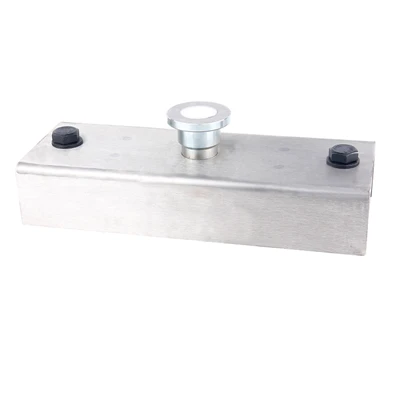
Formwork Fixing Accessories: Pre-drilled counter-sunk nail holes, magnetic fixing plates, or plastic push-in nail flanges for securing embeds against wooden or steel molds.
Surface Treatments: Plain mill finish, shop primer, electro-galvanized, hot-dip galvanized, or stainless steel passivated.

What Buyers Should Provide for Quotation
To receive an accurate engineering review and commercial offer within 24–48 hours, provide the following details:
Detailed Drawings
PDF or DWG files showing plate dimensions, hole patterns, chamfers, and anchor layout (stud diameter, length, and placement).
01
Material Specifications
Required steel grade (e.g., S235JR, S355JR, A36, Stainless 316) and anchor bar steel standard.
02
Surface Finish
Mill finish, hot-dip galvanized (specify layer thickness or standard), zinc-plated, or primed.
03
Quantity Requirements
Volume per item line and projected batch shipping schedules.
04
Quality & Test Requirements
Need for 3.1 MTRs, NDT reports, bend test certificates, or third-party inspection (e.g., SGS, TÜV).
05
FAQ

Request a Quote
Submit your CAD drawings, material requirements, and estimated project quantities to receive a detailed technical evaluation and competitive proposal.
Technical Response Time: 24–48 Hours
Drawing Formats Accepted: DWG, DXF, PDF, STEP
Engineering Support: Connection detailing, tolerance review, and material equivalence matching for overseas standards
We're professional embedded parts & inserts manufacturers and suppliers in China, specialized in providing high quality customized service. We warmly welcome you to wholesale embedded parts & inserts in stock here from our factory.