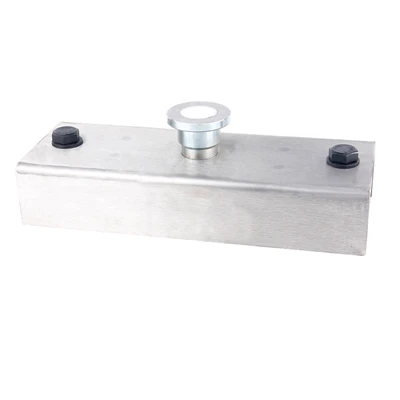
Cast-in steel frames are structural embedment assemblies prefabricated into precast concrete elements to provide high-load attachment points, edge protection, and precise mechanical interface alignment. Engineered for heavy industrial and commercial precast construction, these frames consist of hot-rolled structural steel profiles (channels or angles) welded to continuous or discrete concrete anchors (studs, rebar, or flat steel straps). They transfer shear, tensile, and moment loads directly into the concrete matrix, eliminating site-welding to main reinforcement bars and shortening installation cycles on active job sites.
Key Product Characteristics
Load-Transfer Efficiency: Continuous anchor profiles distribute concentrated structural loads evenly along the concrete edge, preventing localized spalling under dynamic or seismic forces.
Dimensional Stability: Precision jig-welded construction maintains tight geometric tolerances (+/- 1.0 mm) during high-pressure concrete pouring and vibration.
Surface Protection: Hot-dip galvanized (HDG) coating per ASTM A123 / ISO 1461 ensures long-term corrosion resistance in aggressive weathering or marine environments.
Adjustability: Integrated slotted anchor channels allow bolted connection adjustments in three axes, compensating for on-site construction tolerances.
Concrete Integration: Optimized anchor spacing and embedment depths prevent internal stress concentrations and avoid interference with primary rebar mats.
Key Specifications
|
Technical Parameter |
Specification Details & Options |
|
Profile Types |
C-channels (KTA/KTB series), equal/unequal angles, and custom curved or boxed structural sections. |
|
Standard Lengths |
1,000 mm to 6,000 mm (custom cut-to-length options available upon project request). |
|
Anchor Configurations |
Stud anchors, ribbed rebar welded via resistance or CO2 gas-shielded arc welding, and perforated flat steel strap anchors. |
|
Load Capacities |
Shear resistance up to 45 kN/m; tensile resistance up to 35 kN/m (varying by profile dimensions and concrete strength class). |
|
Tolerance & Compliance |
Manufacturing compliance with ISO 13928 for precast steel embedments; dimensional control per ISO 2768-m. |
Grades & Standards
Steel Materials:
• Structural Carbon Steel: Q355B / Q235B (Equivalent to ASTM A572 Gr. 50 / A36).
• Stainless Steel: SS304 / SS316 for corrosive chemical or coastal applications.
Manufacturing & Welding Standards:
• Welding Quality: ISO 3834 compliance; welding operators certified to ISO 9606 / AWS D1.1.
• Dimensional Tolerances: ISO 2768-m for fabricated structural steel components.
Corrosion Protection Standard: Hot-dip galvanizing coating thickness min. 65-85 um conforming to ASTM A123 / ISO 1461.
Applications
Precast Industrial Wall Panels: Edge protection and structural attachment interfaces for multi-story precast buildings.
Infrastructure & Transportation: Tunnel segment connection frames, precast bridge parapets, and highway noise barrier embeds.
Heavy Equipment Foundation Blocks: Cast-in mounting frames for industrial machinery, gantry crane rails, and heavy MEP support brackets.
Architectural Precast Facades: Concealed connection channels for stone or metal cladding panel suspension systems.
Quality & Inspection
Raw Material Traceability: Mill Test Certificates (MTC) verified for chemical composition (C, Si, Mn, P, S) and yield/tensile strength prior to production.
Weld Integrity Testing: 100% visual inspection per ISO 17637; regular magnetic particle testing (MT) and destructive tensile shear tests performed on anchor-to-profile welds.
Galvanizing Inspection: Coating thickness verified using magnetic gauges per ISO 2178; adhesion and uniformity checked via visual and sulfate immersion tests.
Dimensional Verification: Laser scanning and coordinate measuring fixtures used during pilot-run checks to verify hole pitch, slot alignment, and overall length.
Supply & Customization Options
Custom Engineering: Production based on client-provided shop drawings, structural load calculations, or BIM models (Tekla / Revit formats).
Material Variations: Selection of carbon steel with various surface finishes (mill finish, primed, hot-dip galvanized) or full austenitic stainless steel assemblies.
Packaging & Logistics: Bundled on steel pallets with timber separators, secured with heavy-duty steel banding, and wrapped in weather-resistant woven films for ocean freight transport.
Minimum Order Quantity (MOQ): Scalable production runs tailored to project scale, with prototype sampling available for major engineering tenders.
What Buyers Should Provide
To accelerate technical review and quotation accuracy, submit the following project parameters:
Structural Drawings / CAD Files: PDF or DWG/DXF drawings showing profile cross-sections, overall lengths, and hole/slot layouts.
Load Requirements: Ultimate design loads (shear VRd, tension NRd, and bending moments) and governing safety factors.
Concrete Specifications: Minimum characteristic concrete compressive strength (C30/37 or higher) and rebar clearance constraints.
Environmental Exposure Class: Service environment (e.g., indoor dry, exterior urban, coastal marine, or chemical plant) to determine corrosion protection specs.
Quantity & Delivery Schedule: Total meterage or piece count, target delivery port (Incoterms 2020), and required site delivery milestones.
FAQ
Hot Tags: cast-in steel frames, China cast-in steel frames manufacturers, suppliers, factory