Heavy-Duty Precast Lifting Accessories & Drop-Forged Clutch Systems
Precast lifting accessories provide certified structural attachment points and rigging interfaces for stripped, transported, and erected concrete elements. These components transfer tension, shear, and diagonal pull loads directly from lifting hardware through steel reinforcement into the surrounding concrete matrix.
Engineering precast lifting hardware requires precise load group matching, dynamic impact factor calculations, and strict safety factors (typically 3:1 to 5:1 on steel strength and concrete breakout capacity). Installing mismatched or uncertified lifting components risks concrete cracking, structural blowout, shear failure, and severe site safety hazards.
Manufacturing processes utilize forged alloy steel, precision-machined threaded sockets, ductile cast iron, and high-density elastomeric materials. All items meet or exceed European Machinery Directive 2006/42/EC, EN 13155, OSHA 1926.251, and AS 3850 standards.
-
![Precast Lifting Accessories Kits]() Precast Lifting Accessories KitsPrecast lifting accessories kits comprise matched bundles of cast-in anchors, sockets, clutch devices, and formwork formers utilized for the safe demolding, transport, and erection of precast concrete elements. These kits coordinate...view more
Precast Lifting Accessories KitsPrecast lifting accessories kits comprise matched bundles of cast-in anchors, sockets, clutch devices, and formwork formers utilized for the safe demolding, transport, and erection of precast concrete elements. These kits coordinate...view more -
![Lifting Anchor Protection Caps]() Lifting Anchor Protection CapsLifting Anchor Protection Caps (recess plugs or socket caps) are elastomeric and polymer closure components deployed in precast concrete manufacturing. Inserted into concrete recesses immediately after demolding, these caps seal anchor...view more
Lifting Anchor Protection CapsLifting Anchor Protection Caps (recess plugs or socket caps) are elastomeric and polymer closure components deployed in precast concrete manufacturing. Inserted into concrete recesses immediately after demolding, these caps seal anchor...view more -
![Lifting Anchor Recess Formers]() Lifting Anchor Recess FormersLifting anchor recess formers are specialized positioning and void-forming accessories utilized in precast concrete manufacturing. Secured directly to steel or timber formwork prior to concrete placement, these components hold...view more
Lifting Anchor Recess FormersLifting anchor recess formers are specialized positioning and void-forming accessories utilized in precast concrete manufacturing. Secured directly to steel or timber formwork prior to concrete placement, these components hold...view more -
![Threaded Lifting Eyes]() Threaded Lifting EyesThreaded lifting eyes are reusable rigging hardware components screwed directly into pre-buried sockets within precast concrete elements to facilitate safe vertical and angular hoisting, handling, and transport. The assembly connects...view more
Threaded Lifting EyesThreaded lifting eyes are reusable rigging hardware components screwed directly into pre-buried sockets within precast concrete elements to facilitate safe vertical and angular hoisting, handling, and transport. The assembly connects...view more -
![Spherical Head Lifting Clutches]() Spherical Head Lifting ClutchesSpherical head lifting clutches serve as reusable mechanical connecting hardware for hoisting and tilting precast concrete components embedded with matching spherical head (pin) anchors. The assembly consists of a shackle, a locking...view more
Spherical Head Lifting ClutchesSpherical head lifting clutches serve as reusable mechanical connecting hardware for hoisting and tilting precast concrete components embedded with matching spherical head (pin) anchors. The assembly consists of a shackle, a locking...view more -
![Precast Lifting Clutches]() Precast Lifting ClutchesPrecast lifting clutches are specialized mechanical connection hardware engineered to engage pre-embedded pin or spherical head anchors in precast concrete elements. They function as the primary detachable interface between overhead...view more
Precast Lifting ClutchesPrecast lifting clutches are specialized mechanical connection hardware engineered to engage pre-embedded pin or spherical head anchors in precast concrete elements. They function as the primary detachable interface between overhead...view more


Product Range
Precast Lifting Clutches
Quick-release rigging interfaces engineered to engage flat head spread anchors, foot anchors, and two-hole erection anchors.
Load Range: 1.3 Ton to 32.0 Ton SWL (Safe Working Load).
Operation: 360-degree rotation head with 180-degree tilting latch for angular and side-pull applications.
Traceability: Cast batch code, load class marking, and individual serial numbers on every clutch ring.
Spherical Head Lifting Clutches
Heavy-duty clutches designed specifically for spherical head (ball-head) pin anchors embedded in deep or heavy concrete elements.
Load Range: 1.3 Ton to 40.0 Ton SWL.
Key Feature: Hemispherical locking lip prevents accidental disengagement while allowing smooth articulation during element turning and tilting.
Testing: 100% magnetic particle inspected (MPI) with 2x SWL proof load certification.
Threaded Lifting Eyes
Heavy-duty swivel lifting loops and rigid lifting keys engineered for cast-in threaded sockets (Rd12 to Rd52 or Metric threads).
Load Range: 0.5 Ton to 12.5 Ton SWL.
Design: High-grade alloy steel bail on a zinc-plated or stainless steel threaded stud; internal pressure bearings permit 360-degree rotation under load without unscrewing.
Lifting Anchor Recess Formers
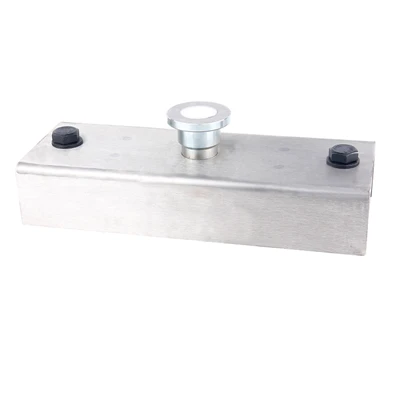
Reusable rubber, polyurethane, and magnetic void formers used to secure lifting anchors to formwork and create the precise concrete pocket needed for clutch engagement.
Types: Round elastomeric formers, narrow edge formers, magnetic steel-cased formers.
Durability: Oil-resistant elastomer formulation withstands up to 300 reuse cycles in harsh concrete plant environments.
Lifting Anchor Protection Caps
Protective sealing caps and plugs designed to seal exposed anchor pockets or threaded sockets post-installation.
Function: Prevents ingress of water, mortar slurry, and debris during transportation, curing, and jobsite storage.
Variants: Flush plastic caps, compressible rubber plugs, and paintable recessed covers.
Precast Lifting Accessories Kits
Complete factory-matched lifting system packages tailored to specific element geometries (slabs, columns, wall panels, utility vaults).
Contents: Cast-in anchors, reinforcement tail templates, matching recess formers, protection caps, and reusable lifting clutches.
Benefit: Eliminates site incompatibility risks by ensuring load-matched components across the entire lifting chain.
Key Product Characteristics
Forged Monolithic Construction: Lifting clutches and anchor bodies are drop-forged from 20CrNiMo or 35CrMo alloy steel without cold joints or structural welds.
Load Group Compatibility Keying: Physical dimensions vary by tonnage group (e.g., 2.5T, 5.0T, 10.0T) to physically prevent undersized clutches from mating with higher-capacity anchors.
Impact & Low-Temperature Resistance: Alloy formulations maintain structural toughness above 27 Joules impact energy at -20 degrees C, meeting cold-weather construction requirements across North America and Northern Europe.
Multi-Axis Load Transfer: Clutches allow full 360-degree horizontal swivel and up to 90-degree vertical articulation, accommodating complex rigging setups without introducing bending moments into the anchor stem.
Corrosion Protection Coatings: Hot-dip galvanizing (HDG per ISO 1461), electro-galvanizing (per ISO 2081), or stainless steel (A2/A4 grades) options prevent rust staining on architectural precast surfaces.

Key Specifications
|
Product Category |
Load Class (SWL) |
Standard Material |
Surface Finish |
Safety Factor |
Standard Compliance |
|
Spherical Head Clutches |
1.3T to 40.0T |
Drop-Forged 35CrMo Steel |
Electro-Galvanized / HDG |
5:1 |
EN 13155, OSHA 1926.251 |
|
Flat Head Spread Clutches |
1.3T to 32.0T |
Drop-Forged 20CrNiMo Alloy |
Yellow Zinc / HDG |
5:1 |
AS 3850, EN 13155 |
|
Threaded Lifting Eyes |
0.5T to 12.5T |
42CrMo Steel / Grade 316 SS |
Zinc Plated / Self-Color |
4:1 |
DIN EN 13155 |
|
Recess Formers |
1.3T to 32.0T |
High-Grade NBR / Polyurethane / Neodymium |
Natural / Anodized Steel |
N/A |
ISO 9001 Factory Std |
|
Threaded Sockets |
0.5T to 12.5T |
Seamless Precision Steel Tube / SS316 |
Zinc Electro-Plated |
3:1 (Concrete) / 5:1 (Steel) |
CEN/TR 15728 |
Applications
Tilt-Up Wall Panels: High shear loads applied during thin-panel tilting and stripping require spread anchors combined with wide-body lifting clutches.
Precast Columns & Beams: Heavy axial tension loads managed by high-capacity spherical head anchors and clutches up to 40 Tons.
Double-Tees & Floor Slabs: Low-profile recessed socket systems and wave-anchors designed to fit thin concrete toppings without breaching lower surface cover limits.
Civil Infrastructure & Utility Vaults: Manholes, culverts, and retaining walls exposed to aggressive groundwater require hot-dip galvanized or A4 stainless steel lifting components.
Architectural Concrete Panels: Recessed anchors fitted with flush-fitting protection caps preserve exterior aesthetic surfaces while preventing post-construction water penetration.

Selection & Design Considerations
Selecting and specifying precast lifting components follows a four-step engineering evaluation process:
Determine Concrete Element Parameters:
Calculate total element weight, accounting for dry concrete weight and formwork adhesion (adhesion factor ranges from 1.1 for oiled steel molds up to 3.0 for deep coffered or un-oiled wooden molds).
Verify concrete compressive strength at initial stripping/lifting (e.g., early-stage 15 MPa vs. full 28-day 40 MPa cured strength).
Account for rigging geometry, sling angles, and crane movement dynamics (dynamic impact factors range from 1.15 to 1.50).
Calculate Required Load per Anchor Point:
Apply the standard load equation: Required Load per Anchor = (Total Weight x Dynamic Factor x Stripping Factor) / (Number of Active Anchors x cos(Sling Angle))
Select Anchor Type & Load Class:
Ensure total slab or wall thickness meets or exceeds the minimum required edge distance and embedment depth.
Conduct an edge distance check: if the distance to the concrete edge is less than 3 times the embedment depth (3 x L), supplementary shear reinforcement tails must be specified.
Evaluate concrete breakout capacity against ultimate steel tensile strength to prevent premature cone failure.
Match Compatible Hardware:
Select a lifting clutch and recess former within the EXACT same load class group as the embedded anchor to ensure safe mechanical locking and physical compatibility.
Critical Design Factors:
• Concrete Compressive Strength at First Lift: Early-stage stripping (e.g., 15 MPa) reduces concrete cone failure resistance compared to 28-day cured strength (40+ MPa). Embedment lengths and supplementary rebar tails must be designed for stripping conditions.
• Dynamic Rigging Factors: Crane movement, acceleration, and wind load require dynamic amplification factors ranging from 1.15 to 1.50.
• Formwork Suction/Adhesion: Oiled steel formwork introduces minimal suction (1.1x factor), whereas smooth wood or deep coffered molds can exert up to 3.0x element weight during vertical stripping.
• Sling Angle Effect: As the angle between sling legs increases past 60 degrees, tension on individual anchors increases exponentially:
Anchor Load = Vertical Force / cos(alpha)
Quality & Inspection
Raw Material Verification
Optical Emission Spectrometry (OES) chemical analysis per heat number.
Tensile testing and ultrasonic internal defect detection on raw alloy steel bars prior to forging.
Manufacturing Quality Control
• Closed-Die Forging: Grain flow alignment verified via metallographic inspection to prevent stress-cracking propagation.
• Non-Destructive Testing (NDT): 100% Magnetic Particle Inspection (MPI) or Dye Penetration Testing (DPT) on all load-bearing lifting clutches to detect surface micro-cracks.
• Heat Treatment: Quenching and tempering monitored via digital heat-log charts to achieve precise HRC hardness ranges (HRC 28 to 34 for clutches).
Final Inspection & Testing
• Proof Load Testing: Every production batch undergoes mechanical testing at 2.0 x SWL on dedicated hydraulic pull test rigs.
• Ultimate Destructive Testing: Sample testing to destruction confirms compliance with the required 5:1 safety factor.
• Traceability & Certification: Mill Test Certificates (MTC per EN 10204 3.1), Batch Proof Load Certificates, and CE Declarations of Conformity provided with every shipment.

Supply & Customization Options
OEM / Private Labeling
Custom laser marking, cast logos, and customized part numbering directly on clutch bodies and former caps.
Dimensional Customization
Custom anchor lengths, plate dimensions, and specialized rebar tail bends tailored to custom precast element geometries.
Surface Finishes
Electro-galvanized (5 to 12 um) for indoor storage and short-term weather exposure.
Hot-Dip Galvanized (HDG, >= 55 um per ISO 1461) for high-humidity and outdoor infrastructure projects.
Stainless Steel AISI 304 (1.4301) / AISI 316 (1.4401) for extreme chemical or marine exposure.
Packaging
Heavy-duty reinforced wooden crates, ISPM 15 heat-treated pallets, steel-strapped boxes, and color-coded plastic bags for quick field identification by load class.
What Buyers Should Provide for Technical Quotation
To receive an accurate engineering evaluation and formal price quotation, provide the following details:
Required Load Class & System Type
System type (e.g., Spherical Head, Flat Head Spread, Threaded Socket) and SWL capacity requirements (e.g., 2.5T, 5.0T).
01
Concrete Element Specifications
Concrete compressive strength at initial lifting/stripping (MPa or PSI).
Minimum element thickness, edge distances, and rebar clearance details.
02
Environmental Exposure & Finish
Coating requirements (Self-color, Electro-zinc, HDG, or Stainless Steel A2/A4).
03
Quantity & Schedule
Estimated annual consumption or project-specific unit quantities, required batch delivery timeline, and port of destination.
04
Certification & Testing Requirements
Need for EN 10204 3.1 certificates, third-party inspection (TUV, SGS), or specific regional compliance documentation.
05
FAQ

Request a Quote
Submit your project requirements to receive a complete technical proposal and factory-direct pricing within 24 hours.
Technical Engineering Support: Send structural drawings or anchor layout plans for engineering validation and load calculations.
We're professional precast lifting accessories manufacturers and suppliers in China, specialized in providing high quality customized service. We warmly welcome you to wholesale precast lifting accessories in stock here from our factory.