


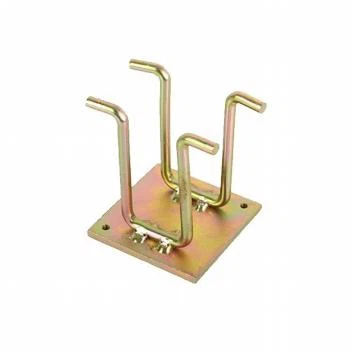
Product Overview
We manufacture cast-in concrete fixing inserts designed to provide permanent, high-load attachment points within precast and cast-in-place concrete structures.
Unlike post-installed expansion or chemical anchors that require post-cure drilling and risk hitting internal rebar, embedded inserts are positioned inside the formwork prior to concrete placement. This pre-planned approach eliminates on-site drilling, prevents micro-cracking in finished concrete surfaces, and significantly accelerates jobsite assembly schedules.
Engineered for precast concrete plants, architectural facade contractors, and structural engineering projects, our inserts absorb and distribute static and dynamic loads directly into the reinforced concrete matrix. We supply standard catalog items as well as custom components manufactured directly to project drawings, load profiles, and international building codes.
Technical Specifications & Manufacturing Capabilities
|
Parameter |
Specification & Standard Options |
|
Product Categories |
Threaded Sleeve Inserts, Lifting Inserts, Anchor Channels, Weldable Anchor Plates |
|
Thread Range |
Metric (M6 to M30), UNC / UNF threads, Heavy-Duty Custom Pitch |
|
Dimensional Tolerance |
Up to +/- 0.5 mm on critical cast-in positioning features; ISO 2 / 6H thread tolerance |
|
Base Materials |
Carbon Steel: Q235B / Q355B / Grade 8.8 Stainless Steel: AISI 304 (1.4301) / AISI 316 (1.4401) / 316L Ductile Iron / Alloy Steel: Custom grades available |
|
Corrosion Protection |
Plain / Light Oiled, Electro-Zinc Plating (5 to 12 um), Hot-Dip Galvanizing (ISO 1461 / ASTM A153, minimum 55 um), Passivation |
|
Concrete Grade Suitability |
Suitable for C20/25 through C50/60 and high-performance precast concrete mixes |
|
Quality Compliance |
ISO 9001:2015, EN 10204 3.1 Material Test Reports (MTRs), Batch Traceability |
Key Advantages
Post-drilling anchor holes in cured concrete introduces site variability, dust generation, noise, and potential structural damage to internal reinforcement bars (rebar). Cast-in concrete inserts overcome these operational bottlenecks by integrating connection points during the element manufacturing phase.
Predictable Load Transfer: Anchor geometries (flanges, wavy ends, cross-pins, and foot plates) mechanically interlock with surrounding concrete to transfer tensile, shear, and combined loads.
Elimination of Site Drilling: Reduces jobsite labor costs and eliminates risk of rebar strikes during secondary installation phases.
Corrosion Isolation: Stainless steel and heavy hot-dip galvanized coatings protect exposed threads while buried anchors remain protected within the alkaline concrete environment.
Precision Edge Distance Control: Pre-fixed formwork mounting ensures exact edge distance and spacing compliance according to structural calculations.
Product Selection Guide by Application
|
Insert Type |
Core Anchorage Mechanism |
Typical Applications |
Primary Benefit |
|
Cast-In Threaded Sleeves |
Internal threads with crimped end, foot plate, or cross-pin |
Machine bases, pipe hangers, bracket fixtures, cable tray supports |
Flush installation; allows repeated bolting/unbolting. |
|
Lifting & Transport Inserts |
Forged foot, wavy tail, or spherical collar engagement |
Precast wall panels, utility vaults, beams, stair flights |
Engineered safety factors for dynamic crane lifting and flipping. |
|
Anchor Channels (C-Profile) |
Hot-rolled or cold-formed channels with welded anchors |
Curtain wall facades, elevator guide rails, stadium seating |
Continuous longitudinal adjustability without drilling. |
|
Weldable Concrete Inserts |
Embedded stud anchors welded to an exposed steel plate |
Structural steel-to-concrete joints, heavy machinery pads |
Provides a weldable structural interface flush with concrete face. |
Types of Concrete Fixing Inserts
Cast-In Threaded Inserts
Threaded sleeve inserts provide internal thread sockets flush with or recessed inside the concrete face. They accept standard metric or imperial bolts for securing equipment, MEP (Mechanical, Electrical, Plumbing) supports, and secondary structural brackets.
- Configurations: Straight tubular sleeves, flanged bottom sleeves, wavy-tail anchor inserts, cross-pin sleeves.
- Substrate Compatibility: Precast slabs, columns, tilt-up panels, and poured-in-place retaining walls.
Concrete Lifting Inserts
Specifically designed and tested to handle dynamic loads during the stripping, transport, and erection of precast concrete elements.
- Configurations: Foot anchors, eye anchors, erection anchors, spread anchors.
- Safety Protocol: Manufactured to strict quality standards to provide high pull-out resistance under temporary erection loads.
Concrete Anchor Channels
C-shaped steel channels embedded with welded anchor studs. Special T-head channel bolts insert into the slot, allowing three-dimensional alignment adjustment.
- Configurations: Plain or serrated channels for high axial shear capacity.
- Primary Advantage: Absorbs structural building tolerances during curtain wall and facade mounting.
Weldable Anchor Plates & Inserts
Consists of steel plates anchored into the concrete via headed studs or rebar legs. The exposed face provides a clean steel surface for structural welding on site.
- Primary Advantage: Ideal for high-shear industrial connections where bolted adjustments are not required.
Material & Corrosion Protection Standards
Base Alloy Options
- Carbon Steel (Structural / High Tensile): Standard choice for indoor, dry environments or temporary lifting applications where cost efficiency is critical.
- Stainless Steel AISI 304 (1.4301): Suitable for external building facades, humid industrial interiors, and general outdoor civil infrastructure.
- Stainless Steel AISI 316 / 316L (1.4401 / 1.4404): Recommended for coastal, marine, splash zone, and high-pollution industrial environments requiring superior resistance to chloride-induced pitting.
Surface Protection Options
- Electro-Zinc Plating (ISO 4042): 5 to 12 microns thickness; suitable for temporary protection or indoor dry applications.
- Hot-Dip Galvanizing (HDG per ISO 1461 / ASTM A153): Minimum 55 to 85 microns coating thickness. Form a durable metallurgical zinc-iron alloy layer for extended outdoor service life.
- Passivation: Acid treatment for stainless steel components to remove free iron contamination and restore the passive chromium oxide surface layer.
Custom OEM Manufacturing & DFM Support
We produce non-standard embedded inserts engineered to custom geometries, specific load criteria, and proprietary precast formwork mounting systems.
| Customer Inquiry | --> | Engineering Review| --> | CNC Machining & | --> | Inspection & MTRs |
| (2D/3D Drawings) | | & DFM Feedback | | Controlled Batch | | (Loads/Dimensions)|
Customization Capabilities:
- Custom Anchor Shapes: Extended embedment lengths, custom foot plate dimensions, non-standard thread pitches.
- Formwork Fixing Accessories: Plastic nail plates, magnetic holding fixing plates, sealing caps to prevent concrete slurry ingress.
- Design Support: Our engineering team conducts Design for Manufacturability (DFM) reviews to optimize insert load capacity while minimizing raw material yield loss.
- Engineering Note: Submit your 2D PDF or 3D STEP/CAD files to receive a detailed technical evaluation and commercial quotation within 12 business hours.
Quality Assurance & Testing Standards
To ensure mechanical reliability within load-bearing concrete assemblies, every production batch follows strict quality control procedures:
Quality Control Protocol
Raw Material Inspection: Incoming steel bars, tubes, and plates are tested for chemical composition via spectrographic analysis and mechanical tensile yield strength.
Precision Machining & Forming: Automatic turning, thread rolling, and robotic welding processes maintain tight tolerances on internal threads and anchor geometry.
Slurry Ingress Protection Checks: Threaded sleeves are checked for internal cleanliness and thread gauge compliance (GO/NO-GO plug gauges).
Destructive Mechanical Testing: Sample inserts undergo laboratory pull-out (tensile) and shear load testing inside concrete block matrixes to verify ultimate load limits and failure modes.
Documentation Support: Mill Test Certificates (EN 10204 3.1), coating thickness verification reports, and batch inspection certificates accompany every shipment.
Primary Applications & Industries Serviced
Precast Concrete Manufacturing: Wall panels, hollow-core slabs, stair flights, precast columns, drainage culverts.
Facade & Curtain Wall Engineering: Bracket anchor points for glass curtain walls, natural stone cladding, and aluminum composite panels.
Civil Infrastructure: Tunnel lining segments, bridge noise barriers, railway noise walls, retaining wall panels.
Industrial Construction: Crane runway supports, heavy machinery foundations, pipe rack anchorage, cable tray mounting.
FAQ
Hot Tags: concrete fixing inserts, China concrete fixing inserts manufacturers, suppliers, factory, Straight Ferrule Insert


