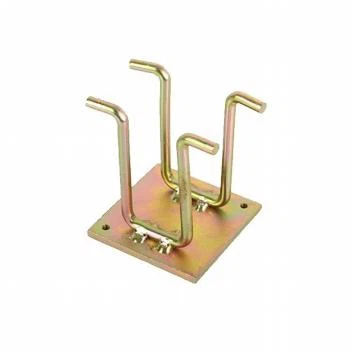
Product Overview
Anchor Socket Inserts are cast-in fastening components designed to provide secure threaded connection points inside precast and concrete structures. Installed before concrete pouring, the insert becomes permanently integrated with the concrete element, allowing bolts, lifting devices, brackets, and other components to be installed without additional drilling after curing.
Compared with traditional post-installed anchors, Anchor Socket Inserts help reduce installation time, avoid concrete surface damage, and improve positioning accuracy, making them widely used in precast concrete manufacturing, modular construction, infrastructure projects, and industrial applications.
As a professional manufacturer, we supply standard and customized Anchor Socket Inserts for global distributors, precast concrete producers, and construction suppliers, with controlled production processes to ensure consistent quality in bulk orders.
Cast-In Anchor Sockets Outperform Post-Installed Anchors
|
Feature / Metric |
Cast-In Anchor Socket Inserts |
Post-Installed Mechanical Anchors |
Chemical Adhesive Anchors |
||
|
Installation Timing |
Placed in formwork before pour |
Drilled after concrete hardens |
Drilled & injected after cure |
||
|
Concrete Stress & Cracking |
Zero expansion stress |
High risk of micro-cracks |
Risk of spalling during drilling |
||
|
Load Transfer Mechanism |
Direct mechanical interlock |
Friction / Expansion force |
Chemical bonding agent |
||
|
Rebar Interference Risk |
Zero (Pre-positioned) |
High (Drill bit damage risk) |
High (Drill bit damage risk) |
||
|
Job-Site Labor Cost |
Minimal |
High (Drilling & cleaning) |
Very High (Long curing time) |
||
|
Flush Mounting Surface |
100% Flush, clean finish |
Protruding anchor bolts |
Protruding threaded rods |
||
Core Engineering Features & Anchor Geometries
1. High-Interlock Anchorage Geometries
Forged Foot Anchor Body: Spreads tensile loads outward into the concrete cone, preventing pull-out in thin precast elements.
Knurled & Ribbed Surface: Increases surface friction to prevent the insert from spinning when tightening high-torque structural bolts.
Cross-Hole Anchor Design: Allows reinforcement steel pins to pass directly through the socket for extreme mechanical retention in heavy civil applications.
2. High-Precision Thread Machining
Threads are produced using automated cold heading and CNC thread rolling, verified with Go/No-Go plug gauges. This guarantees seamless thread engagement on job sites without binding or thread damage.
3. Anti-Concrete Ingress Protection
Concrete slurry entering the thread cavity during pouring and vibration causes severe delays. We provide heavy-duty plastic sealing plugs, rubber end caps, or removable foam plugs to keep internal threads completely clean until final assembly.
Technical Specifications & Materials
Corrosion Resistance & Material Options
- Carbon Steel (Class 4.8 / 8.8): Cost-effective solution for indoor precast panels, dry structural joints, and temporary bracing points.
- Hot-Dip Galvanized Steel (HDG): Coated according to ISO 1461 (50um - 85um zinc layer). Delivers 500+ hours of salt spray resistance for outdoor infrastructure and exterior sandwich walls.
- Stainless Steel (AISI 304 / AISI 316): Ultimate corrosion protection for marine structures, wastewater treatment plants, and coastal precast installations.
Technical Data Summary
|
Parameter |
Standard Capability |
|
Product Name |
Anchor Socket Inserts / Cast-In Threaded Socket |
|
Thread Standards |
Metric Coarse (M8 - M30), UNC, UNF (3/8" - 1-1/4") |
|
Manufacturing Process |
Cold Forging, Hot Heading, Precision CNC Machining |
|
Surface Treatments |
White/Yellow Zinc Plated, Hot-Dip Galvanized (HDG), Dacromet |
|
Load Categories |
Axial Tension, Direct Shear, Combined Tension/Shear, Temporary Lifting |
|
Quality Inspections |
100% Thread Gauge Check, Tensile Load Testing, Chemical Spectrometry |
|
Certifications |
ISO 9001:2015, EN 10204 3.1 MTC, CE Compliance |
Rigorous Quality Control
We operate a complete quality management protocol to eliminate field defects and guarantee full material traceability for structural engineers and project auditors.
Raw Material Certification: Every coil or steel bar undergoes chemical and mechanical testing. Mill Test Reports are archived per heat number.
Precision Thread Audit: Production runs undergo calibrated Go/No-Go gauge testing every 30 minutes to maintain pitch diameter accuracy.
Plating & Coating Testing: Galvanized and zinc-plated batches are measured for layer thickness and tested via Neutral Salt Spray (NSS) testing.
Destructive Tensile Testing: In-house pull-out tests in poured concrete blocks verify Ultimate Tensile Load (UTL) and Safe Working Load (SWL) limits.
EN 10204 3.1 Documentation: Issued with every shipment, providing complete transparency for tensile strength, yield strength, and chemical composition.
OEM & Custom Manufacturing Workflow
For specialized infrastructure projects or proprietary building designs, we offer complete OEM engineering and production:
Technical Drawing Review: Submit your 2D/3D CAD files (STEP, DWG, PDF). Our team verifies thread engagement, load capacity, and wall thickness.
Prototyping & Tooling: Custom tooling is built in-house. Initial samples (5 - 10 pieces) are produced within 5 to 7 business days.
Sample Verification: Mechanical pull-out testing and surface finish checks are completed before mass production approval.
Automated Mass Production: High-speed cold heading and CNC lines run volume orders with strict batch control.
Export Packaging: Sockets are packed in rust-inhibitor lined boxes, heavy-duty cartons, and heat-treated export plywood pallets.
Typical Precast & Structural Applications
Precast Wall Panels & Floor Slabs: Flush-mounted structural anchor points for diagonal panel braces and temporary alignment rigs.
Precast Beams & Columns: Pre-set connection points for structural steel framing, brackets, and ledger angles.
Modular & Prefabricated Buildings: Embedded fixing points for rapid module-to-module assembly and transport anchoring.
Infrastructure Construction: Bridge parapets, tunnel linings, noise barrier walls, and highway retention barriers.
Industrial Machinery Foundations: Cast-in sockets for mounting heavy equipment, conveyor bases, and structural supports.
FAQ
Hot Tags: anchor socket inserts, China anchor socket inserts manufacturers, suppliers, factory, Straight Ferrule Insert